
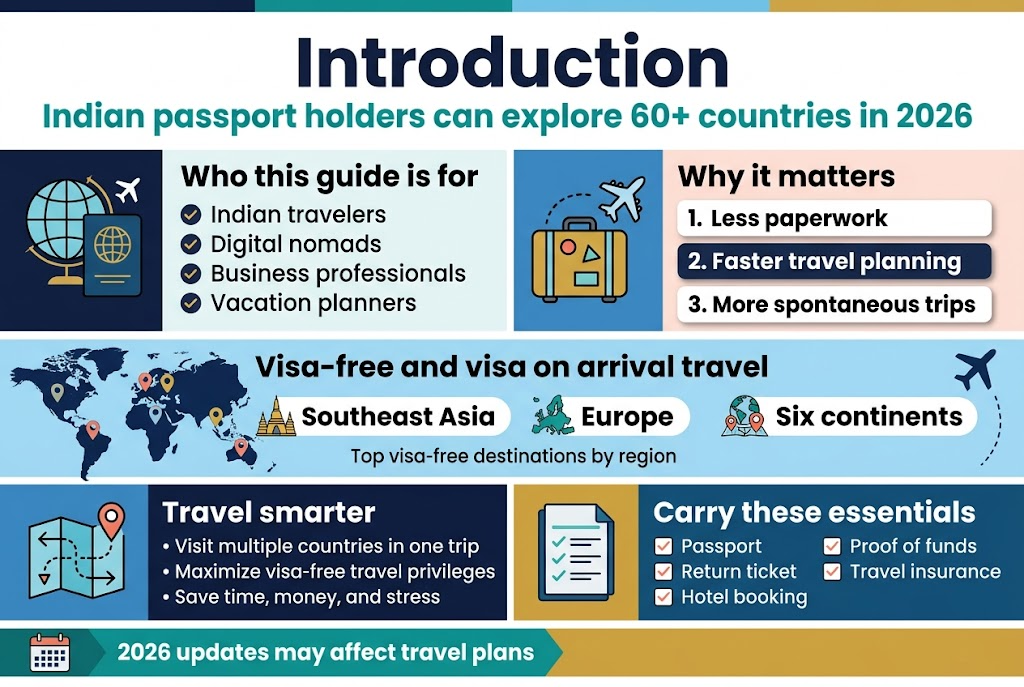
Indian passport holders can now explore 60+ countries without the hassle of lengthy visa applications in 2026. This comprehensive guide is designed for Indian travelers, digital nomads, business professionals, and vacation planners who want to maximize their travel opportunities with minimal paperwork.
Travel freedom has expanded significantly for Indian citizens, with more destinations offering visa free countries for Indians and streamlined visa on arrival options. From tropical beaches in Southeast Asia to historic cities in Europe, Indian passport visa free travel opens doors to incredible experiences across six continents.
We'll break down the top visa-free destinations by region, helping you discover hidden gems and popular hotspots that welcome Indian travelers without advance visa requirements. You'll also learn about strategic travel planning techniques to visit multiple countries in one trip, making the most of your visa free travel privileges. Finally, we'll cover the essential documentation you need to carry and the latest updates for 2026 that could impact your travel plans.
Whether you're planning a quick weekend getaway or an extended multi-country adventure, understanding your visa options as an Indian passport holder can save you time, money, and stress while opening up a world of spontaneous travel possibilities.
Understanding Visa-Free and Visa-on-Arrival Travel for Indian Citizens
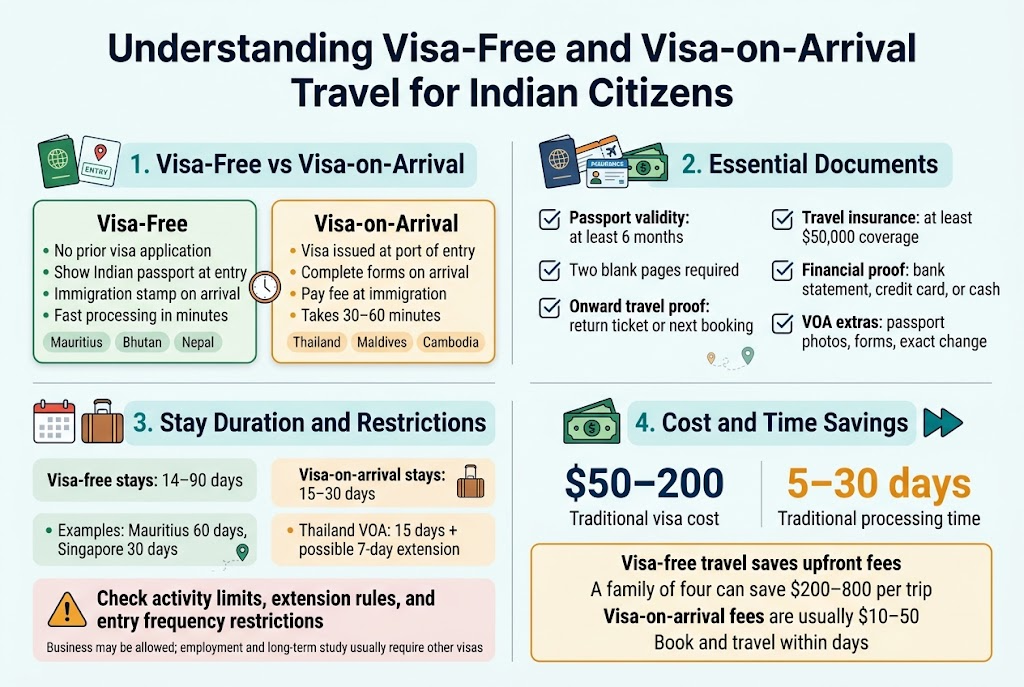
Key differences between visa-free and visa-on-arrival destinations
Visa-free countries for Indians allow you to enter without any prior visa application or approval process. You simply show up at the airport with your Indian passport, and immigration officers stamp your entry. Countries like Mauritius, Bhutan, and Nepal fall into this category, making them perfect for spontaneous travel plans.
Visa-on-arrival destinations require you to obtain your visa at the port of entry. While you don't need to apply beforehand, you'll need to complete paperwork and pay fees upon arrival. Countries like Thailand, Maldives, and Cambodia offer this convenience to Indian passport holders.
The main difference lies in processing time and preparation. Visa-free destinations get you through immigration in minutes, while visa-on-arrival locations might take 30-60 minutes depending on queues and documentation verification.
Essential documents required for hassle-free travel
Your Indian passport must have at least six months validity remaining and two blank pages for entry stamps. Most visa free destinations for Indian passport holders also require proof of onward travel, such as return flight tickets or confirmed bookings to your next destination.
Travel insurance has become increasingly important, especially post-pandemic. Many countries now mandate coverage of at least $50,000 for medical emergencies. Keep digital and physical copies of your insurance policy readily accessible.
Financial proof requirements vary by destination. Some countries require bank statements showing sufficient funds for your stay, typically $50-100 per day. Others accept credit cards or cash declarations at immigration.
For countries offering VOA to Indians, prepare passport-sized photographs, completed visa application forms (often available online), and exact change for visa fees in local currency or US dollars.
Maximum stay durations and travel restrictions
Most visa free countries Indians can visit offer stays between 14 to 90 days. Popular destinations like Mauritius allow 60 days, while Singapore permits 30 days for tourism purposes. These durations are usually non-extendable, so plan your itinerary accordingly.
Visa on arrival countries for India passport holders often provide 15-30 day stays initially, with extension possibilities available in-country. Thailand's visa-on-arrival grants 15 days, but you can extend for another 7 days by visiting immigration offices.
Some destinations impose restrictions on activities allowed during visa-free stays. Business meetings might be permitted, but employment or long-term study usually requires separate visa categories. Always check specific country requirements, as violations can result in deportation and future travel bans.
Entry frequency restrictions also apply. Some countries limit visa-free entries to twice per year or impose mandatory gaps between visits to prevent misuse of tourist privileges.
Cost savings compared to traditional visa applications
Traditional visa applications for Indian citizens often cost $50-200 per person, plus additional fees for documentation, photographs, and sometimes visa service centers. Processing times can stretch from 5-30 days, requiring advance planning and potential travel disruptions if applications are delayed.
Travel destinations without visa for Indians eliminate these upfront costs entirely. A family of four can save $200-800 per trip by choosing visa-free destinations over countries requiring advance applications.
Visa-on-arrival fees are typically lower than embassy-processed visas, ranging from $10-50 for most destinations. You pay only when you actually travel, reducing financial risk if plans change.
Time savings prove equally valuable. Instead of scheduling embassy appointments, gathering extensive documentation, and waiting weeks for approval, you can book flights and travel within days of deciding your destination. This flexibility allows you to take advantage of last-minute flight deals and spontaneous vacation opportunities that would otherwise be impossible with traditional visa requirements.
Top Visa-Free Destinations for Indians by Region
Southeast Asian countries offering immediate entry
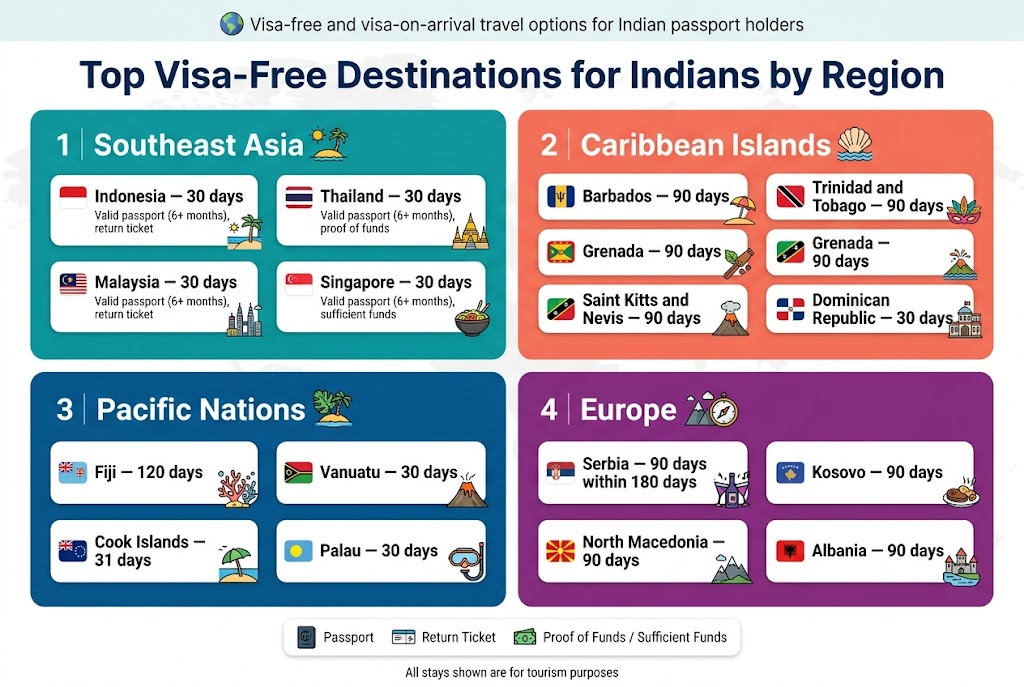
Indonesia tops the list of visa free countries for Indians, allowing 30-day stays for tourism purposes. You can explore Bali's stunning beaches, Jakarta's vibrant culture, or Yogyakarta's ancient temples without any visa hassle. Thailand offers 30-day visa-free access, making it perfect for discovering Bangkok's street food scene, Chiang Mai's mountains, or the pristine beaches of Phuket and Krabi.
Malaysia welcomes Indian passport holders for up to 30 days visa-free, opening doors to Kuala Lumpur's iconic Petronas Towers, Penang's UNESCO heritage sites, and the breathtaking landscapes of Langkawi. Singapore provides 30-day visa-free entry, ideal for experiencing this modern city-state's impressive skyline, world-class shopping, and diverse culinary offerings.
| Country | Duration | Entry Requirements |
|---|---|---|
| Indonesia | 30 days | Valid passport (6+ months), return ticket |
| Thailand | 30 days | Valid passport (6+ months), proof of funds |
| Malaysia | 30 days | Valid passport (6+ months), return ticket |
| Singapore | 30 days | Valid passport (6+ months), sufficient funds |
Caribbean islands welcoming Indian travelers
Barbados stands out among visa free destinations for Indian passport holders, offering 90-day stays without prior visa requirements. This Caribbean gem provides pristine beaches, rum distilleries, and vibrant local culture. Trinidad and Tobago grants 90-day visa-free access, perfect for experiencing Carnival season or exploring the country's diverse ecosystems.
Grenada allows 90-day stays for Indians, making it easy to discover the "Spice Isle" with its nutmeg plantations and underwater sculpture park. Saint Kitts and Nevis offers 90-day visa-free entry, providing access to volcanic landscapes and luxury resorts.
The Dominican Republic extends 30-day visa-free access to Indian citizens, opening opportunities to explore Punta Cana's beaches or Santo Domingo's colonial architecture.
Pacific nations with open-door policies
Fiji welcomes Indian travelers for up to 120 days without requiring advance visas, making it one of the most generous visa free countries for Indians. This Pacific paradise offers world-class diving, traditional Fijian culture, and stunning island landscapes.
Vanuatu provides 30-day visa-free access, allowing exploration of active volcanoes, pristine coral reefs, and unique Melanesian culture. The Cook Islands grants 31-day stays without prior visas, perfect for discovering unspoiled beaches and laid-back island life.
Palau offers 30-day visa-free entry for Indian passport holders, providing access to some of the world's best diving sites and jellyfish lakes. These Pacific destinations represent excellent choices for Indians seeking tropical getaways without visa complications.
European destinations accessible without prior visas
Serbia leads European countries offering VOA to Indians, providing 90-day visa-free access within any 180-day period. Belgrade's nightlife, Novi Sad's cultural festivals, and the country's medieval monasteries become easily accessible.
Kosovo allows 90-day visa-free stays for Indian citizens, offering opportunities to explore Pristina's emerging food scene and the country's mountainous landscapes. North Macedonia grants 90-day visa-free access, making it simple to discover Skopje's unique architecture and Ohrid's ancient lakeside beauty.
Albania provides 90-day visa-free entry, opening doors to the Albanian Riviera's stunning coastline and the country's rich historical sites. These Balkan nations offer affordable European experiences without the typical visa requirements that other European destinations demand from Indian passport visa free travel seekers.
Popular Visa-on-Arrival Countries for Indian Passport Holders
Middle Eastern destinations with airport visa facilities
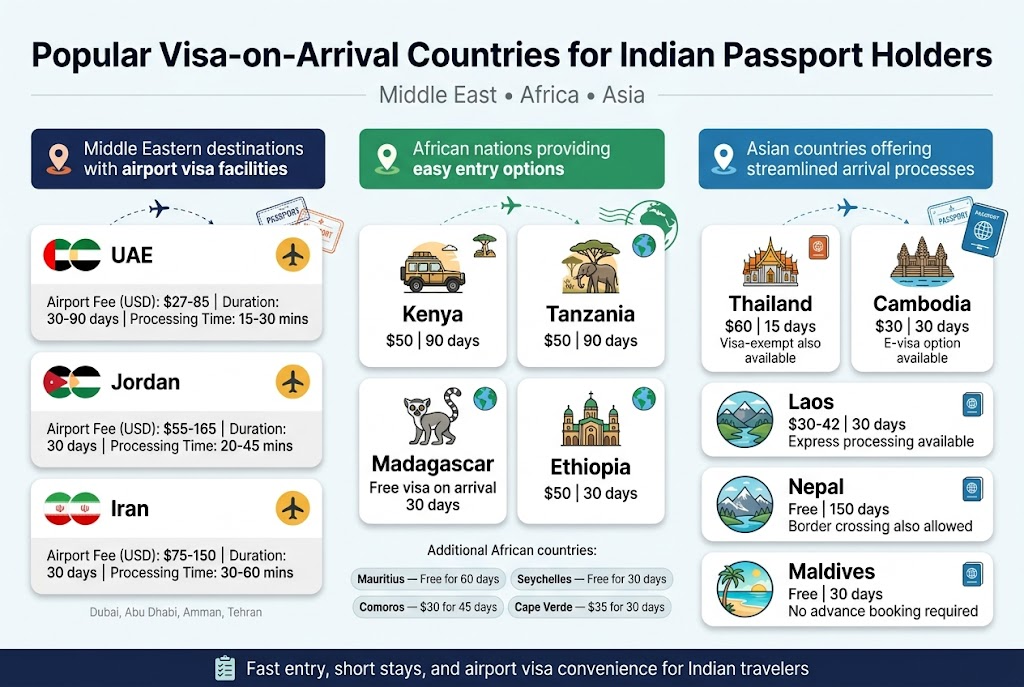
The Middle East offers some of the most convenient visa on arrival countries for India passport holders, making it a gateway to both business and leisure travel. The United Arab Emirates leads this category with its seamless airport visa process, allowing Indian citizens to obtain a visa on arrival at Dubai, Abu Dhabi, and other major airports for tourism and business purposes. The process typically takes 15-30 minutes and costs around AED 100-315 depending on the duration of stay.
Jordan provides another excellent option with its visa on arrival facility at Queen Alia International Airport in Amman. Indian travelers can obtain a single-entry visa valid for 30 days, making it perfect for exploring Petra, the Dead Sea, and other historical sites. The fee ranges from 40-120 Jordanian Dinars based on the length of stay.
Iran also offers visa on arrival for Indian passport visa free travel enthusiasts at major international airports including Tehran's Imam Khomeini International Airport. The process requires a valid passport, return ticket, and hotel reservation, with fees around $75-150 depending on the visa duration.
| Country | Airport Fee (USD) | Duration | Processing Time |
|---|---|---|---|
| UAE | $27-85 | 30-90 days | 15-30 mins |
| Jordan | $55-165 | 30 days | 20-45 mins |
| Iran | $75-150 | 30 days | 30-60 mins |
African nations providing easy entry options
Africa presents numerous visa on arrival countries for Indian travelers seeking adventure, wildlife experiences, and cultural immersion. Kenya stands out as one of the most popular destinations, offering electronic visas and visa on arrival at Jomo Kenyatta International Airport in Nairobi. Indian citizens can explore the Maasai Mara, Mount Kenya, and coastal regions with a tourist visa costing $50 for 90 days.
Tanzania welcomes Indian passport holders with visa on arrival facilities at Dar es Salaam and Kilimanjaro airports. The country charges $50 for a single-entry tourist visa valid for 90 days, perfect for Serengeti safaris, Zanzibar beach holidays, and Mount Kilimanjaro expeditions.
Madagascar offers one of the most straightforward visa processes for Indians, with free visa on arrival for stays up to 30 days and minimal fees for extended periods. This makes it an attractive destination for exploring unique wildlife and pristine landscapes.
Ethiopia provides visa on arrival at Addis Ababa Bole International Airport, charging $50 for a 30-day tourist visa. The country serves as an excellent base for exploring ancient churches in Lalibela and the Danakil Depression.
Additional African countries offering VOA to Indians include:
-
Mauritius (free for 60 days)
-
Seychelles (free for 30 days)
-
Comoros ($30 for 45 days)
-
Cape Verde ($35 for 30 days)
Asian countries offering streamlined arrival processes
Asia provides numerous countries offering VOA to Indians with efficient processing systems designed for quick entry. Thailand remains one of the most popular visa free destinations for Indian passport holders, offering visa on arrival at all major airports including Bangkok's Suvarnabhumi and Don Mueang airports. The process costs 2,000 Thai Baht (approximately $60) for a 15-day stay, though many Indians prefer the visa-exempt entry for shorter trips.
Cambodia has revolutionized its visa process with both electronic visas and traditional visa on arrival options. At Phnom Penh and Siem Reap airports, Indian travelers can obtain a 30-day tourist visa for $30, making it convenient for exploring Angkor Wat and other historical sites.
Laos offers visa on arrival at Wattay International Airport in Vientiane and Luang Prabang Airport, charging $30-42 depending on the processing speed. The landlocked country provides excellent opportunities for adventure travel and cultural experiences.
Nepal, sharing a border with India, offers free visa on arrival for Indian citizens at Tribhuvan International Airport in Kathmandu. This makes it incredibly convenient for short trips to explore the Himalayas, ancient temples, and vibrant local culture.
Maldives has one of the most tourist-friendly policies, providing free 30-day visa on arrival for all visitors including Indians. The tropical paradise requires only a valid passport, confirmed accommodation, and proof of sufficient funds for the stay.
| Country | Fee (USD) | Duration | Special Notes |
|---|---|---|---|
| Thailand | $60 | 15 days | Visa-exempt also available |
| Cambodia | $30 | 30 days | E-visa option available |
| Laos | $30-42 | 30 days | Express processing available |
| Nepal | Free | 150 days | Border crossing also allowed |
| Maldives | Free | 30 days | No advance booking required |
Strategic Travel Planning for Multiple Destinations
Creating Efficient Multi-Country Itineraries
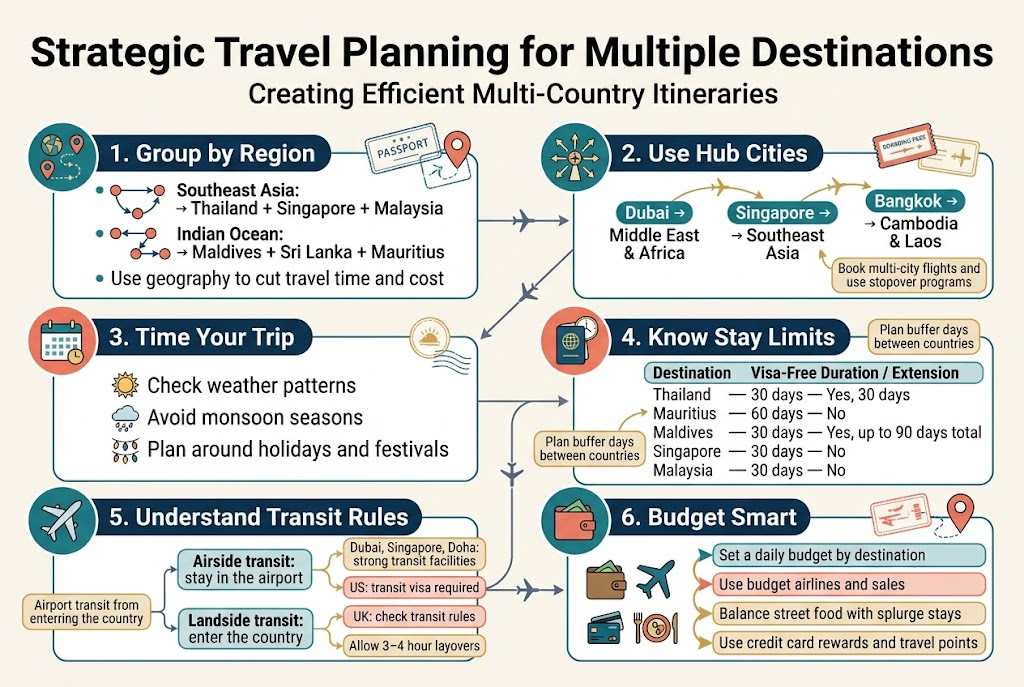
Planning a trip across multiple visa free countries for Indians requires strategic thinking about geography, flight connections, and seasonal timing. Start by grouping destinations within the same region to minimize travel time and costs. For example, combine Southeast Asian countries like Thailand, Singapore, and Malaysia in one trip, or explore the Maldives alongside Sri Lanka and Mauritius in the Indian Ocean region.
Consider hub cities as your base for exploring nearby destinations. Dubai works perfectly for accessing visa free destinations for Indian passport holders in the Middle East and Africa, while Singapore serves as an excellent gateway to Southeast Asia. Bangkok offers convenient connections to neighboring countries offering VOA to Indians like Cambodia and Laos.
Flight routing plays a crucial role in maximizing your itinerary efficiency. Book multi-city tickets instead of round-trip flights to save money and time. Many airlines offer stopover programs that let you explore an additional city at no extra airfare cost - Emirates in Dubai, Singapore Airlines in Singapore, and Turkish Airlines in Istanbul.
Timing your visits according to peak seasons can make or break your experience. Research weather patterns, local holidays, and festival seasons for each destination. Avoid monsoon seasons in tropical countries and plan around major celebrations that might affect accommodation availability and prices.
Maximizing Stay Durations Across Different Regions
Understanding the specific duration limits for each visa free destination helps you optimize your travel timeline. Most countries offering visa free travel to Indians allow stays between 30 to 90 days, but some have unique restrictions worth noting.
Mauritius offers 60 days visa-free, while the Maldives provides 30 days - perfect for combining both destinations in a two-month trip. Thailand's 30-day visa-free policy can be extended for an additional 30 days at immigration offices, effectively giving you two months to explore the country thoroughly.
| Destination | Visa-Free Duration | Extension Possible |
|---|---|---|
| Thailand | 30 days | Yes, 30 days |
| Mauritius | 60 days | No |
| Maldives | 30 days | Yes, up to 90 days total |
| Singapore | 30 days | No |
| Malaysia | 30 days | No |
Plan buffer days between countries to account for potential delays or spontaneous extended stays. Some travelers use the "visa run" strategy - briefly exiting and re-entering a country to reset their stay duration, though this practice has become increasingly restricted.
Consider the cumulative time limits some regions impose. The Schengen area, though not entirely visa-free for Indians, has similar concepts that might apply to future agreements.
Understanding Transit Visa Requirements
Transit requirements can trip up even experienced travelers, especially when connecting through countries that aren't your final destination. Indian passport holders need to understand the difference between airside transit (staying in the international zone) and landside transit (entering the country).
Many major hub airports allow 24-48 hour transit without a visa if you don't leave the airport. Dubai, Singapore, and Doha airports offer excellent facilities for extended layovers, including sleeping areas, showers, and city tours for qualifying passengers.
However, some countries require transit visas regardless of your stay duration. The US requires a transit visa for Indian citizens even for brief connections, while the UK has specific transit visa requirements depending on your final destination and airline.
Research your airline's policies on checked baggage during multi-city trips. Some carriers require you to collect and recheck bags during certain connections, which means you'll need to clear immigration and customs - potentially requiring a visa.
Book flights with adequate connection times, especially in airports known for long immigration queues. A minimum 3-4 hour layover gives you breathing room for delays and immigration procedures.
Planning Budget-Friendly Extended Trips
Extended travel across multiple destinations requires careful budget planning and smart money-saving strategies. Start by setting a daily budget for each destination based on local costs - Southeast Asian countries typically cost less than Middle Eastern or island destinations.
Accommodation costs can be dramatically reduced through advance booking, loyalty programs, and alternative lodging options. Many booking platforms offer significant discounts for stays longer than a week. Consider apartment rentals for longer stays in expensive destinations like Singapore or the Maldives.
Transportation between countries often represents the largest expense. Look for budget airline sales, especially during off-peak seasons. Airlines like AirAsia, Scoot, and SpiceJet frequently offer promotional fares for regional routes.
Food costs vary dramatically between destinations. Countries like Thailand and Malaysia offer incredible street food at budget prices, while places like the Maldives require resort dining that can quickly drain your budget. Plan your splurge destinations carefully and balance them with budget-friendly countries.
Take advantage of credit card reward programs and travel points for flights and hotels. Many Indian credit cards offer bonus points for international spending and partnerships with airline loyalty programs that can significantly reduce your travel costs.
Essential Travel Requirements and Documentation
Passport Validity and Blank Page Requirements
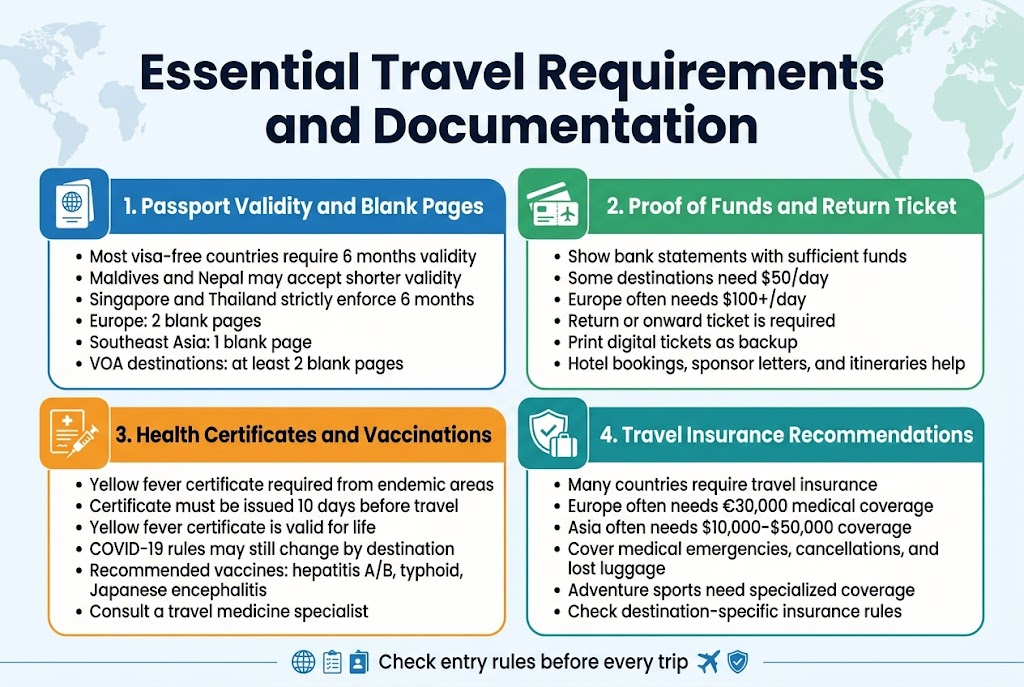
Indian passport holders need to check specific validity requirements before planning their trips. Most visa free countries for Indians require passports to be valid for at least six months from the date of entry. Some destinations like the Maldives and Nepal accept passports with shorter validity periods, while others such as Singapore and Thailand strictly enforce the six-month rule.
Blank page requirements vary significantly across destinations. European countries typically need two blank pages for entry and exit stamps, while Southeast Asian nations often require just one. Countries offering VOA to Indians usually need at least two blank pages to accommodate the visa sticker and entry stamps.
Smart travelers carry passports with multiple blank pages to avoid last-minute complications. Running out of blank pages during multi-country trips can force expensive emergency passport renewals at Indian consulates abroad.
Proof of Funds and Return Ticket Necessities
Financial documentation proves your ability to support yourself during travel. Most countries expect Indian citizens to show bank statements reflecting sufficient funds for their stay duration. The required amount varies from $50 per day for some Southeast Asian countries to $100+ daily for European destinations.
Return tickets or onward journey proof is mandatory for almost all visa free destinations for Indian passport holders. Immigration officers want assurance that visitors won't overstay their permitted duration. Digital tickets work fine, but printing copies prevents smartphone battery or connectivity issues at border crossings.
Some countries accept hotel confirmations and sponsor letters as additional financial proof. Business travelers can use company invitation letters, while tourists should prepare hotel bookings and detailed itineraries showing planned expenses.
Health Certificates and Vaccination Requirements
Yellow fever vaccination certificates are mandatory when traveling from or through endemic areas. Countries like Kenya, Uganda, and several African nations strictly enforce these requirements for Indian travelers. The certificate must be issued at least 10 days before travel and remains valid for life.
COVID-19 requirements have evolved significantly, with most destinations dropping mandatory vaccination certificates by 2026. However, some countries still require proof of vaccination or negative tests during health emergencies. Check current health advisories before departure.
Routine vaccinations like hepatitis A/B, typhoid, and Japanese encephalitis are recommended for specific regions. Travelers visiting rural areas or staying for extended periods should consult travel medicine specialists for personalized vaccination schedules.
Travel Insurance Recommendations for Each Destination
Travel insurance has become essential for Indian passport visa free travel, with many countries now requiring minimum coverage amounts. European destinations often mandate insurance covering €30,000 in medical expenses, while Asian countries typically require $10,000-$50,000 coverage.
Choose comprehensive policies covering medical emergencies, trip cancellations, and lost luggage. Adventure activities like skiing or diving need specialized coverage that standard policies exclude. Read policy terms carefully to understand coverage limitations and claim procedures.
Different regions have specific insurance requirements. Middle Eastern countries often require Islamic banking-compliant insurance products, while some African nations need coverage for evacuation services. Research destination-specific requirements and purchase appropriate coverage before departure.
Recent Changes and Updates for 2026
Newly added visa-free agreements
Several exciting developments have emerged for Indian passport holders in 2026, with new bilateral agreements expanding travel opportunities. Thailand extended its visa-free policy for Indians from 30 to 60 days, making it one of the most significant changes this year. This extension particularly benefits business travelers and tourists planning longer stays in Southeast Asia.
Malaysia introduced a 30-day visa-free entry program for Indian citizens, marking a major shift in their immigration policy. The agreement covers tourism, business meetings, and family visits, opening up new possibilities for spontaneous travel to Kuala Lumpur and beyond.
Armenia also joined the list of visa free countries for Indians, offering 180-day visa-free access annually. This development creates excellent opportunities for exploring the Caucasus region and serves as a gateway to nearby countries.
| Country | Visa-Free Duration | Effective Date | Purpose Allowed |
|---|---|---|---|
| Thailand | 60 days | January 2026 | Tourism, Business |
| Malaysia | 30 days | March 2026 | Tourism, Business, Family |
| Armenia | 180 days/year | February 2026 | All purposes |
Modified entry requirements and restrictions
Many destinations have updated their entry protocols while maintaining visa-free access. Singapore now requires Indians to show proof of accommodation and return tickets, though the 30-day visa-free period remains unchanged. The city-state also introduced mandatory health insurance coverage of at least $30,000 for stays exceeding 15 days.
The Maldives updated its arrival procedures, requiring all visitors to complete an online health declaration 24 hours before travel. While still offering 30-day visa-free access, travelers must now show confirmed hotel reservations or invitation letters from local hosts.
Several European countries offering VOA to Indians have implemented stricter financial requirements. Georgia increased its minimum bank balance requirement to $2,000 for the previous three months, while maintaining its 365-day visa-free policy.
Countries with suspended visa-free access
Political changes and security concerns led to temporary suspensions in some regions. Myanmar suspended its visa-on-arrival program for all nationalities, including Indians, due to ongoing internal situations. Travelers now need to obtain visas through embassies before departure.
Tunisia temporarily halted its visa-free program for Indian citizens following administrative reviews. The suspension affects the previous 90-day visa-free access and requires Indians to apply for regular tourist visas through consular offices.
Belarus modified its visa-free transit program, reducing the permitted stay from 30 to 5 days for Indians traveling through Minsk airport. The change affects travelers planning extended layovers or short visits to the country.
Anticipated policy changes throughout the year
Several countries are expected to announce significant updates to their visa policies for Indian travelers. Qatar is reportedly considering extending its visa-free period from 30 to 90 days, potentially making it a major hub for longer Middle Eastern travels.
The UAE is reviewing options to expand its current visa policies, with discussions about introducing longer-term visa-free access for frequent business travelers. Current intelligence suggests announcements may come in the second half of 2026.
Indonesia is evaluating the expansion of its 30-day visa-free program to include more entry points and extended duration options. The country aims to boost tourism from India and may announce changes during the peak travel season.
European Union discussions continue about streamlining visa processes for Indian business travelers, though no concrete timeline exists for implementation. These potential changes could significantly impact visa requirements for Indian travelers visiting multiple EU destinations.
Stay updated with official embassy announcements and government travel advisories, as policies can change rapidly based on diplomatic relations and security assessments.
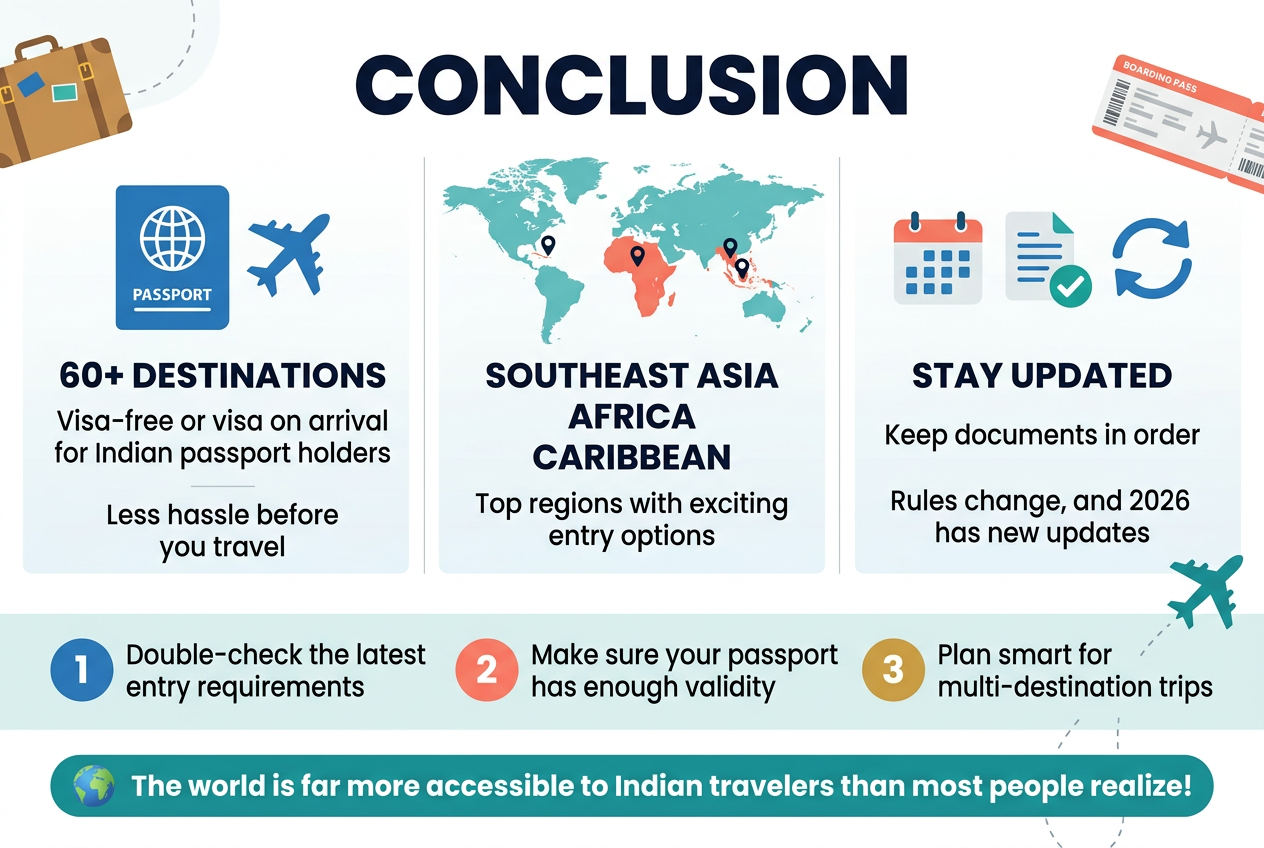
Traveling the world as an Indian passport holder is more exciting than ever, with over 60 destinations welcoming you without the hassle of pre-arranged visas. From the tropical beaches of Southeast Asia to the stunning landscapes of Africa and the Caribbean, there's genuinely a lot on the table. Knowing which countries offer visa-free access and which ones let you grab a visa right at the airport can save you serious time, money, and stress when putting your travel plans together.
The key is to stay updated, keep your documents in order, and plan smart — especially when you're combining multiple destinations in one trip. Rules change, new agreements get signed, and 2026 has already brought some fresh updates worth knowing about. So before you book your next adventure, double-check the latest entry requirements for your chosen destination, make sure your passport has enough validity, and go explore. The world is far more accessible to Indian travelers than most people realize!
Post a Comment