
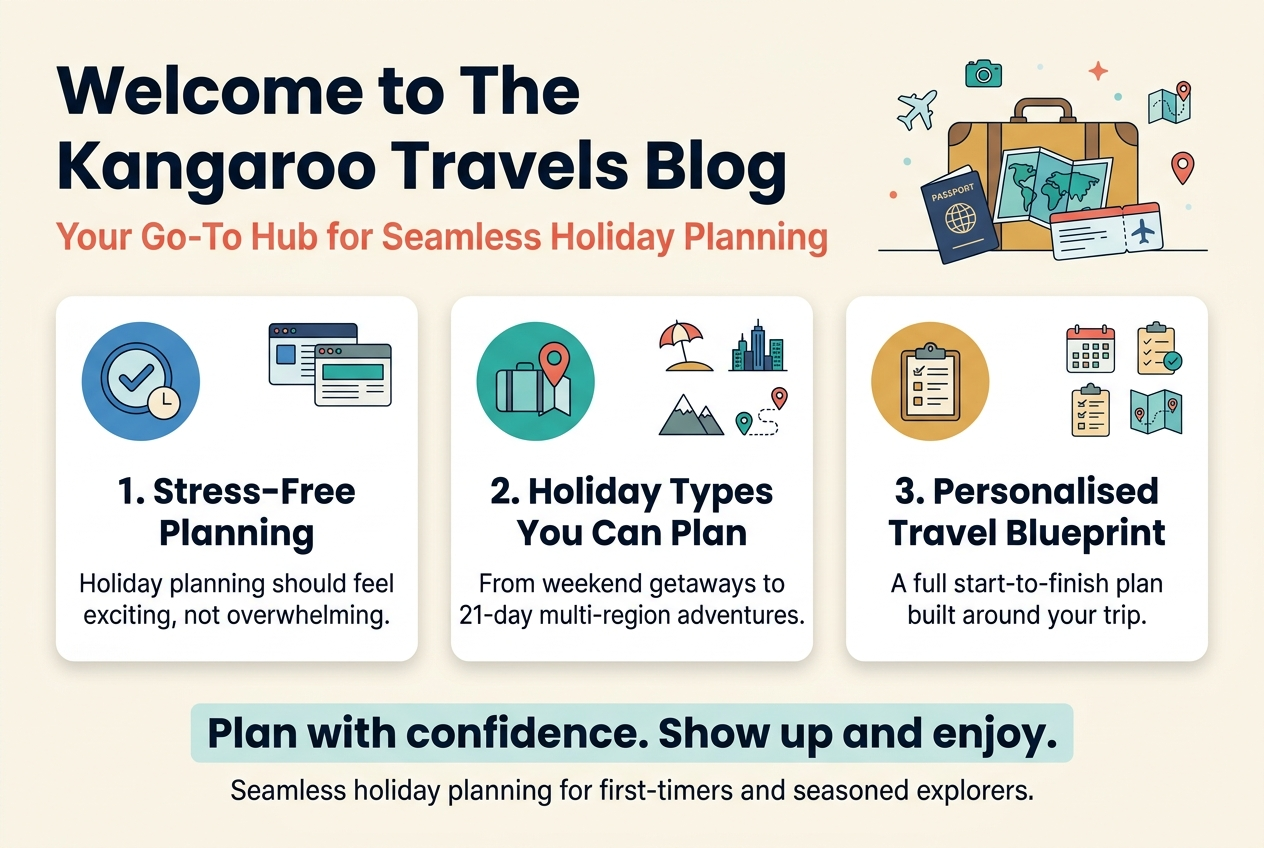
Welcome to The Kangaroo Travels Blog: Your Go-To Hub for Seamless Holiday Planning
Planning a holiday should feel like the best part of the trip — not the part that keeps you up at night staring at 47 open browser tabs. If you're a traveller who wants every detail sorted before you even pack your bag, you're in the right place.
The Kangaroo Travels Blog is built for people who love to travel but want the planning done properly — from first-timers piecing together their first big trip to seasoned explorers chasing something more meaningful than a generic package deal.
Here's what we'll cover in this post:
-
Why holiday planning doesn't have to be stressful — and how the right approach changes everything
-
The types of holidays you can plan with expert guidance — from quick weekend getaways to epic 21-day multi-region adventures
-
What a personalised travel blueprint actually includes — and how the planning process works from start to finish
By the end, you'll have a clear picture of how seamless holiday planning works, and what it looks like when someone maps out your entire trip so you can just show up and enjoy it.
Why Holiday Planning Should Be Exciting, Not Overwhelming
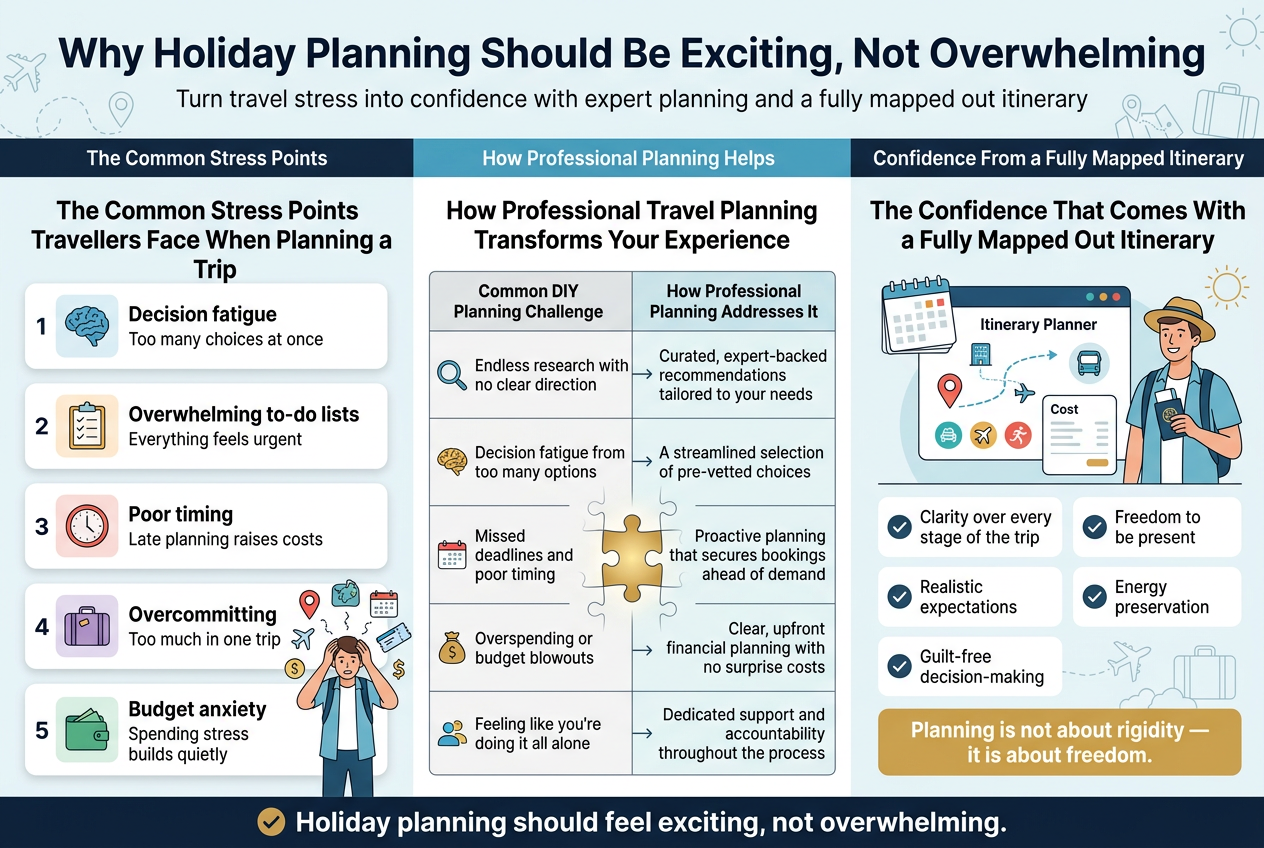
The Common Stress Points Travellers Face When Planning a Trip
Holiday planning carries the promise of adventure, relaxation, and unforgettable memories — yet for many travellers, the process itself becomes a source of genuine anxiety long before any bags are packed. The moment you sit down to plan, the sheer volume of decisions can feel crushing.
Some of the most common stress points travellers encounter include:
-
Decision fatigue — Choosing destinations, accommodation, transport, activities, and dining options all at once leads to mental exhaustion. When decision-making capacity is depleted, travellers default to rushed or uninformed choices.
-
Overwhelming to-do lists — Without a clear system, every task feels equally urgent, making it impossible to prioritise effectively.
-
Poor timing — Waiting too long to plan means preferred options are no longer available, prices climb, and the entire experience starts on the back foot.
-
Overcommitting — Trying to fit too much into a single trip, or saying yes to every suggestion, drains energy and turns a holiday into an exhausting checklist exercise.
-
Budget anxiety — Without a clear spending plan in place from the start, financial stress quietly builds alongside excitement, often overshadowing the experience entirely.
Research into holiday stress patterns consistently highlights that the anxiety travellers feel is rarely about the destination itself — it is almost always about the process of getting there. When planning feels chaotic, travellers arrive at their destination already worn out, which defeats the very purpose of taking a break.
The good news is that every one of these stress points is preventable. With the right support and structure in place, planning a holiday can feel every bit as enjoyable as the holiday itself.
How Professional Travel Planning Transforms Your Experience
With this in mind, it becomes clear why professional travel planning makes such a profound difference. The transformation is not simply about convenience — it is about reclaiming your headspace and your time.
A professional travel planner brings clarity to what can otherwise feel like an unmanageable puzzle. Much like building a jigsaw from the edges inward, expert guidance helps you anchor the most important elements of your trip first, allowing everything else to fall naturally into place. This approach directly counters the chaos that comes from trying to plan everything simultaneously.
Here is how professional travel planning changes the experience:
| Common DIY Planning Challenge | How Professional Planning Addresses It |
|---|---|
| Endless research with no clear direction | Curated, expert-backed recommendations tailored to your needs |
| Decision fatigue from too many options | A streamlined selection of pre-vetted choices |
| Missed deadlines and poor timing | Proactive planning that secures bookings ahead of demand |
| Overspending or budget blowouts | Clear, upfront financial planning with no surprise costs |
| Feeling like you're doing it all alone | Dedicated support and accountability throughout the process |
One of the most valuable things a professional travel planner offers is the ability to make thoughtful decisions rather than desperate ones. When you are not scrambling to figure everything out solo, you are free to focus on what actually matters — anticipating the experience ahead rather than managing logistical anxiety.
Professional planning also removes the isolation many travellers feel when attempting to organise a complex trip alone. Having expert guidance means you are never left second-guessing whether you have made the right choices, because every recommendation is grounded in knowledge and experience.
The Confidence That Comes With a Fully Mapped Out Itinerary
Now that we have covered how professional planning reshapes the experience, it is worth exploring the very tangible confidence that comes from holding a fully mapped out itinerary in your hands.
When every detail of your trip is clearly laid out — where you are staying, how you are getting there, what you are doing each day, and what it will cost — something shifts. The mental load lifts. Instead of carrying a constant background hum of did I remember everything?, you step into your holiday with genuine peace of mind.
A well-constructed itinerary delivers confidence in the following ways:
-
Clarity over every stage of the trip — You know exactly what to expect, which eliminates the anxiety of the unknown.
-
Freedom to be present — Without logistics constantly pulling at your attention, you can actually enjoy each moment as it unfolds rather than worrying about what comes next.
-
Realistic expectations — A thoughtful itinerary is built around what you can genuinely enjoy, not an overpacked schedule that leaves you more exhausted than when you left.
-
Guilt-free decision-making — When you know your priorities are already protected in the plan, you can say no to distractions without feeling like you are missing out.
-
Energy preservation — Planning ahead means your energy is spent on experiencing your holiday, not managing it in real time.
Ultimately, a fully mapped out itinerary is not about rigidity — it is about freedom. When the foundations are solid, you have the confidence to relax, explore, and embrace spontaneity without fear that something important has been overlooked. That is the difference between a holiday you survive and one you genuinely savour.
Types of Holidays You Can Plan With Expert Guidance
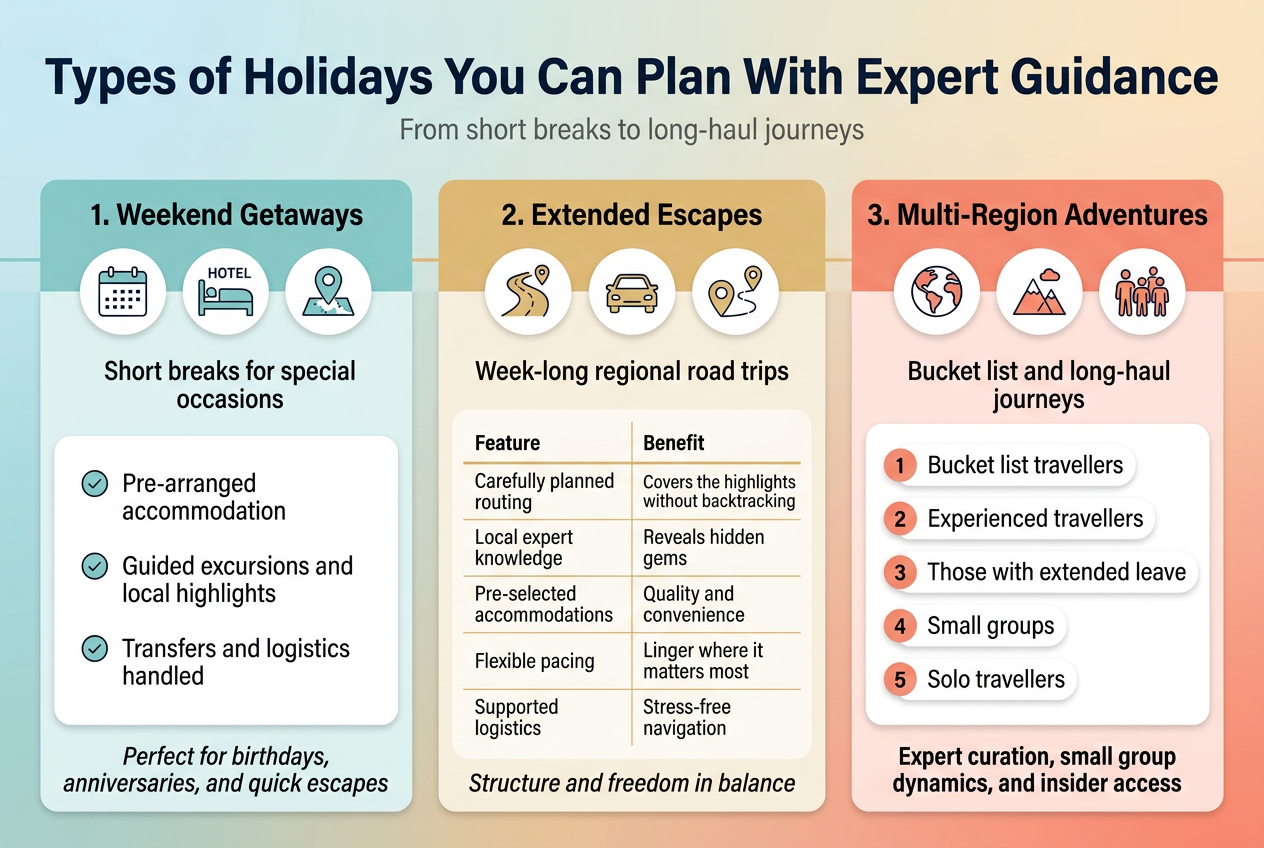
Weekend Getaways for Short Breaks and Special Occasions
Not every memorable holiday requires weeks of planning or an extended time away from home. Short breaks are a brilliant way to explore a new corner of the world or revisit a much-loved destination without the commitment of a lengthy trip. Whether you are celebrating a birthday, an anniversary, or simply craving a change of scenery, a well-planned weekend getaway can deliver an experience that feels far larger than its duration suggests.
With expert guidance, these short breaks are carefully matched to destinations that pack meaningful experiences into a compact itinerary. Rather than scrambling to figure out where to stay, what to see, and how to get around, you benefit from a thoughtfully structured plan that makes every hour count. Think charming European cities, sun-drenched coastal towns, or culturally rich destinations where guided excursions are already woven into the schedule — leaving you free to simply enjoy the moment.
Key advantages of a guided short break include:
-
Pre-arranged accommodation suited to the destination and style of travel
-
Guided excursions that highlight the best of what a destination has to offer
-
Transfers and logistics handled so you arrive relaxed and ready to explore
-
Flexibility to enjoy leisure time alongside structured sightseeing
Special occasions deserve more than a rushed, self-planned trip. With the right guidance, even a two or three-night escape can feel like a genuinely luxurious and seamless experience.
Extended Escapes for Week-Long Regional Road Trips
Now that we have covered the appeal of short breaks, it is worth exploring what becomes possible when you have a full week or more to work with. Extended escapes open the door to a richer, more immersive style of travel — particularly when they take the form of regional road trips that allow you to move through a destination at your own pace while still benefiting from expert support.
A week-long regional journey is ideal for travellers who want more than a single base. Rather than spending all your time in one city or resort, you move through a broader landscape, uncovering smaller towns, scenic routes, and local experiences that a standard package holiday rarely reaches. Approaches like 4x4 self-drive adventures, for instance, allow you to set your own pace and stop where curiosity leads, all while being guided by carefully chosen routes and local knowledge.
This style of travel is particularly well-suited to destinations with diverse regional character — where the landscape, cuisine, culture, and atmosphere shift noticeably as you travel from one area to the next. A regional road trip through such a destination transforms a single holiday into what feels like several distinct experiences rolled into one.
What an extended escape with expert guidance typically offers:
| Feature | Benefit |
|---|---|
| Carefully planned routing | Ensures you cover the highlights without backtracking |
| Local expert knowledge | Reveals hidden gems that guidebooks often overlook |
| Pre-selected accommodations | Chosen for their quality and proximity to key experiences |
| Flexible pacing | Allows you to linger where it matters most |
| Supported logistics | Removes the stress of navigating unfamiliar roads and regions |
For travellers who want to go further and experience more depth, the week-long regional escape strikes the perfect balance between structure and freedom.
Multi-Region Adventures for Bucket List and Long-Haul Journeys
With this in mind, next we will look at the most ambitious category of holiday planning — multi-region adventures designed for bucket list travellers and those embarking on long-haul journeys to far-flung destinations. These are the trips that require the most careful preparation, the deepest local knowledge, and the most thoughtful curation of experiences.
Multi-region adventures typically span several countries or vast stretches of a single large country, connecting a series of culturally and geographically distinct destinations into one cohesive journey. A journey following the ancient Silk Route across China's vast landscapes, for example, might connect the cosmopolitan buzz of a modern city with the historic riches of ancient trading hubs, UNESCO-listed desert cave art, and remote regions that few travellers ever reach. These are not holidays you piece together from a search engine — they are experiences that demand expertise, insider access, and a genuine understanding of the places involved.
Expert-led small group tours are particularly well-suited to this style of travel. Travelling with like-minded people enhances the experience through shared moments and collective discovery, while charismatic expert guides and trusted local hosts bring places to life in ways that no guidebook can replicate. Access to leading specialists — whether a conservationist and award-winning photographer or an author and regional specialist — transforms a long-haul journey into something genuinely extraordinary.
Multi-region adventures are ideal for:
-
Bucket list travellers ready to tick off a long-dreamed destination
-
Experienced travellers seeking deeper immersion beyond familiar tourist trails
-
Those with extended leave who want to make the most of their time away
-
Small groups of friends or family looking for a shared adventure with meaningful connections
-
Solo travellers who want the security and camaraderie of a guided group experience
The combination of expert curation, small group dynamics, and insider access ensures that these long-haul journeys deliver on the promise of extraordinary travel — helping you see the world better and go far, together.
What a Personalised Travel Blueprint Covers
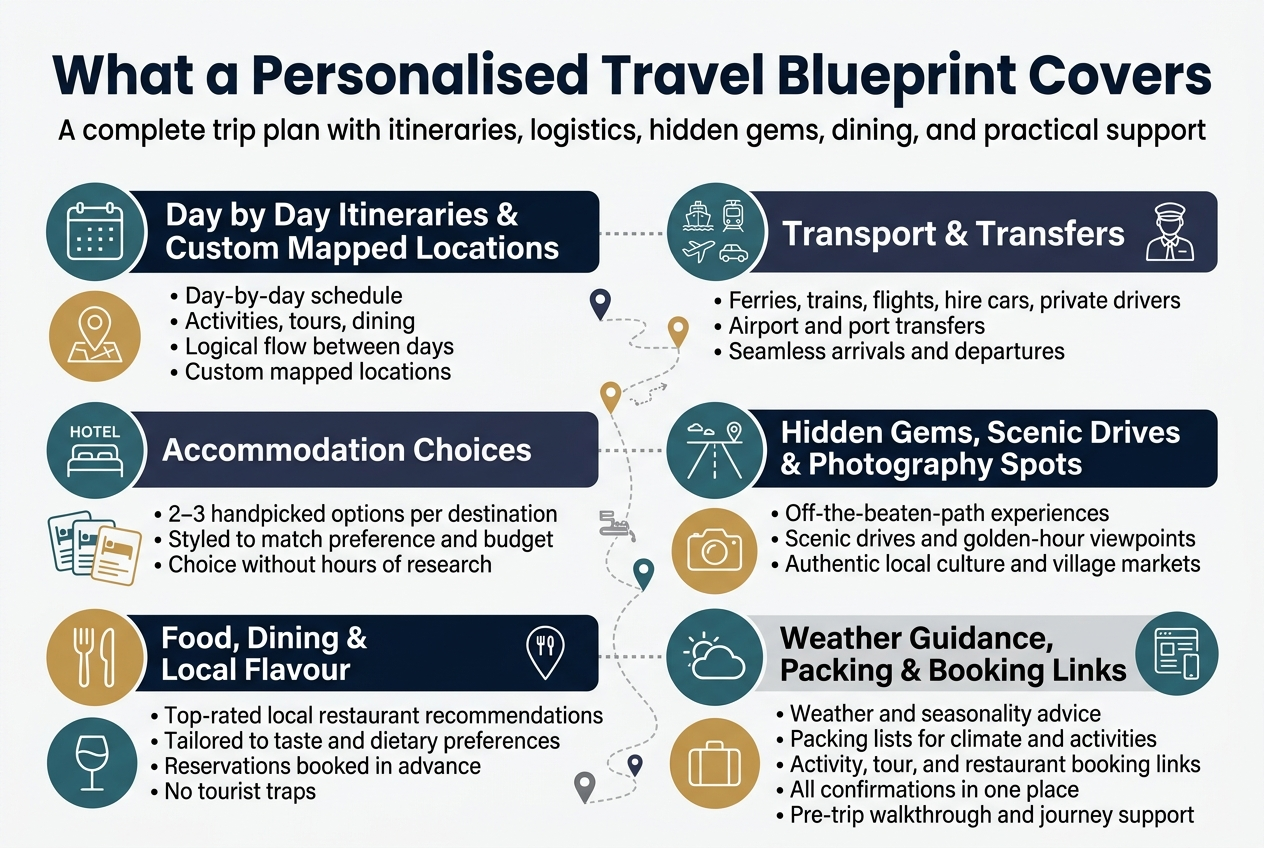
Day by Day Itineraries and Custom Mapped Locations
A personalised travel blueprint is far more than a rough list of places to visit. At its core, it delivers a beautifully presented, day-by-day itinerary where every moment is thoughtfully planned to suit your preferences — including activities, tours, and dining experiences. Each day flows logically into the next, removing the mental load of figuring out what to do, where to go, and how long to spend somewhere.
Beyond the daily schedule, a solid travel blueprint also sorts all your transport logistics. Whether that involves ferries, trains, internal flights, hire cars, or private drivers, every connection between destinations is mapped out so you are never left guessing. Private transfers from airports and ports to your accommodation are handled seamlessly, meaning your arrival and departure are smooth and stress-free from the very first moment.
Accommodation is another key element woven into the itinerary. Rather than offering a single option and leaving you to hope for the best, a well-crafted blueprint provides two to three handpicked accommodation choices per destination — each carefully selected to match your style, preference, and budget — so you retain a sense of choice without the hours of research.
Now that we have covered the structural foundation of the itinerary, it's worth looking at what makes these blueprints truly special for curious, experience-driven travellers.
Hidden Gems, Scenic Drives and Photography Spots
One of the most valuable aspects of a personalised travel blueprint is its ability to move you beyond the obvious tourist trail. Rather than directing you to the same landmarks photographed by millions, an expert-crafted plan incorporates authentic local experiences that genuinely immerse you in the culture and character of each destination.
For photographers, road-trippers, and those who simply want to see a place as locals do, this means the itinerary can be built around scenic drives through landscapes most visitors never discover, photography spots with extraordinary light and framing opportunities, and experiences that reveal the true personality of a region rather than its postcard version.
This level of curation is only possible because the planning is handled by someone with deep destination knowledge — someone who understands which coastal road at golden hour is worth the detour, which village market is genuinely worth waking up early for, and which viewpoint most travellers completely miss. For immersive travellers especially, these off-the-beaten-path inclusions transform a good holiday into an extraordinary one.
With this in mind, the next layer of a personalised blueprint adds something every traveller looks forward to — great food.
Food, Dining and Local Flavour Recommendations
No travel experience is truly complete without memorable meals, and a well-designed travel blueprint treats food as a core pillar of the journey rather than an afterthought. Top-rated local restaurant recommendations are included directly within the itinerary, each one tailored specifically to your tastes and dietary preferences rather than simply listing popular venues.
These recommendations go beyond generic suggestions. They are selected to reflect authentic local flavour — the kinds of places that reveal something genuine about a destination's culinary identity. Whether your style leans toward waterfront seafood, regional street food, family-run trattorias, or elevated fine dining, the recommendations within your blueprint reflect what you actually enjoy eating.
For those who want to take the experience even further, dining reservations can be made in advance on your behalf. This eliminates queues, removes the stress of last-minute scrambles for a table in a busy city, and ensures you walk into every meal already knowing it will be exactly what you were hoping for. No tourist traps, no disappointing compromises — just carefully chosen restaurants booked and ready for you to enjoy.
Previously, I've outlined the experiences and flavours that fill each day. Now let's turn to the practical layer that keeps everything running smoothly.
Weather Guidance, Packing Lists and Booking Links
A personalised travel blueprint doesn't leave you to navigate practical details alone. One of the most useful inclusions is preparation support — ensuring you arrive at your destination properly equipped for the climate, the activities planned, and the conditions you're likely to encounter.
Seasonality and weather play a significant role in how a trip feels and functions. Knowing whether to pack layers for unpredictable mountain weather, light breathable fabrics for a humid coastal climate, or waterproof gear for a region known for afternoon rain can make a meaningful difference to your comfort and enjoyment. This guidance is built into a thoughtful travel blueprint so nothing is left to chance.
On the booking side, links for activities, tours, and restaurant reservations are included within the itinerary so everything is accessible in one place. Rather than jumping between multiple websites, email threads, and confirmation documents, all your bookings and confirmations are organised and delivered in a clear, easy-to-navigate format — including via a dedicated app in some services, where your final itinerary lives neatly in one place.
Before departure, a pre-trip walkthrough of the entire itinerary ensures you feel completely prepared and confident. And with support available throughout your journey for any questions that arise, you are never left to manage the unexpected entirely on your own.
How the Personalised Travel Planning Process Works
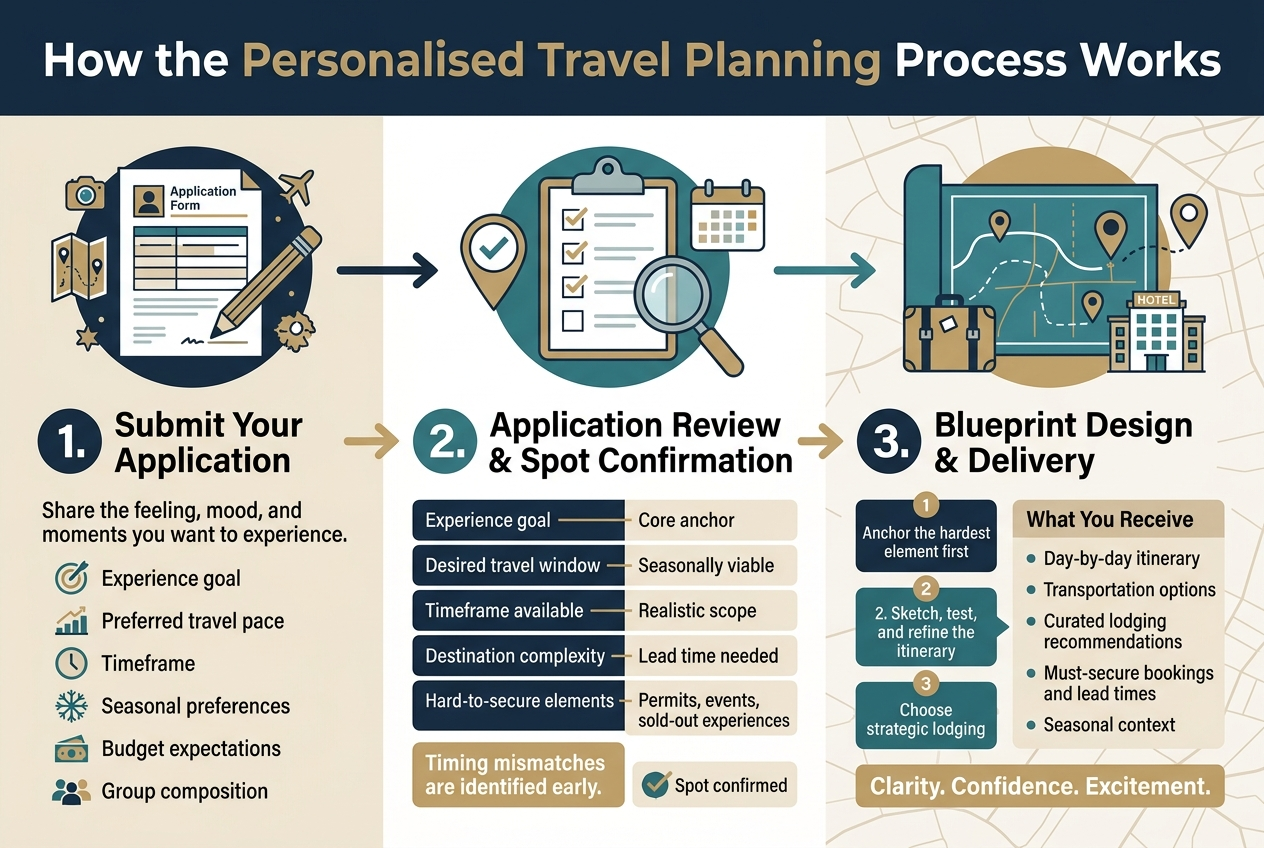
Submitting Your Application and Sharing Your Travel Style
Getting started with personalised travel planning begins with a single, intentional step: submitting your application. This is not a generic enquiry form. It is the foundation upon which your entire holiday blueprint will be built, which is why the information you share at this stage matters enormously.
When filling out your application, you will be asked to articulate what you actually want to experience — not just a destination name, but the feeling, the mood, and the moments you are chasing. Think less along the lines of "I want to go to Italy" and more along the lines of "I want to photograph lemon orchards in Sicily at golden hour" or "I want to stand in lavender fields at sunrise in Provence." The more specific you are, the more purposeful and precise your blueprint will be.
Beyond the experience itself, your application captures essential details about your travel style, including:
-
Your preferred travel pace — do you thrive on fast-moving, activity-packed itineraries, or do you recharge through slower, more immersive stays?
-
Your timeframe — how many days can you realistically dedicate to travel, including recovery days on either end?
-
Seasonal preferences — are you chasing tulip season, autumn foliage, northern lights, or something else that has a narrow window?
-
Your budget expectations — so that lodging, activities, and transportation recommendations are grounded in reality from the outset
-
Group composition — whether you are travelling solo, as a couple, with family, or in a group, each configuration changes the entire planning approach
This stage is not about logistics. It is about vision. The application process is designed to extract the clarity that most travellers struggle to find on their own — so that the planning that follows is responsive, not generic.
Application Review and Spot Confirmation
Once your application has been submitted, it moves into a careful review process. This is not an automated system that spits out a templated response. Each application is assessed individually to ensure that the details provided are sufficient to design something truly tailored.
During the review stage, the focus is on understanding the interplay between a few critical factors:
| Factor | What It Determines |
|---|---|
| Experience goal | The core anchor for every planning decision |
| Desired travel window | Whether the experience is seasonally viable |
| Timeframe available | The realistic scope and pace of the itinerary |
| Destination complexity | How much lead time is needed for bookings |
| Hard-to-secure elements | Permits, events, or experiences that sell out early |
One of the most important things assessed at this stage is whether the timing aligns with the experience. Some experiences simply do not wait — tulips bloom briefly, northern lights require extended darkness, and specific festivals fall on fixed dates. If there is a mismatch between what you want and when you want it, this is identified early so the plan can be adjusted before it goes any further. Catching this at the review stage prevents disappointment later.
Following the review, your spot is confirmed. This confirmation signals that your application has been accepted, your travel vision is workable, and the blueprint design phase can begin. It is worth noting that spots are not unlimited — the review process exists partly to ensure that each traveller receives the level of attention their holiday planning deserves, rather than rushing through a high volume of generic itineraries.
Blueprint Design and What to Expect on Delivery
With this in mind, once your spot is confirmed, the real work begins. The blueprint design phase is where your experience goal, travel style, timeframe, and seasonal context are woven together into a structured, practical, and enjoyable holiday plan.
The design process follows a deliberate sequence rather than jumping straight to bookings. Here is how it unfolds:
1. Anchoring Around the Hardest Element First
Before flights, before lodging, the first question asked is: what is the single hardest thing to secure? This might be a safari permit, a ticket to a specific festival, a unique guided experience, or a property that books out months in advance. Whatever it is, it gets locked in first. Everything else in the blueprint is built around it.
2. Sketching, Testing, and Refining the Structure
A full draft of your itinerary is sketched out — covering locations, possible dates, activity sequencing, and transportation between places. Critically, this draft is then tested for realism:
-
Are transfer times between locations actually achievable?
-
Is the pace sustainable, or does it create fatigue?
-
Are there too many location changes within the timeframe?
-
Does every element remain connected to the original experience goal?
This is an iterative process. If a ferry only runs twice a day, the schedule adjusts. If a drive turns out to be longer than initially assumed, the structure simplifies. Planning at this level is not linear — it is responsive, and that responsiveness is what separates a well-designed itinerary from one that looks good on paper but unravels on arrival.
3. Strategic Lodging Recommendations
Accommodation is not selected randomly. It is chosen based on its proximity to your core experiences, how transportation actually connects your chosen locations, and whether the property supports the rhythm of your days — whether that means early morning starts to catch golden light, or slower afternoons to absorb a destination fully.
What You Receive on Delivery
When your personalised travel blueprint is delivered, it is a comprehensive document that brings your entire holiday into focus in one place. You can expect it to include:
-
A day-by-day itinerary with location, pacing, and activity flow
-
Transportation options between each stop
-
Curated lodging recommendations suited to your style and budget
-
Notes on must-secure bookings and their lead times
-
Seasonal context and what to expect at each destination during your window
Previously, we explored what a personalised travel blueprint covers in detail — and at the delivery stage, all of those elements come together as a unified, ready-to-use plan. The goal is that when you receive your blueprint, you are not left with more questions. You are left with clarity, confidence, and genuine excitement for the holiday ahead.
Destinations Worth Planning Your Next Holiday Around
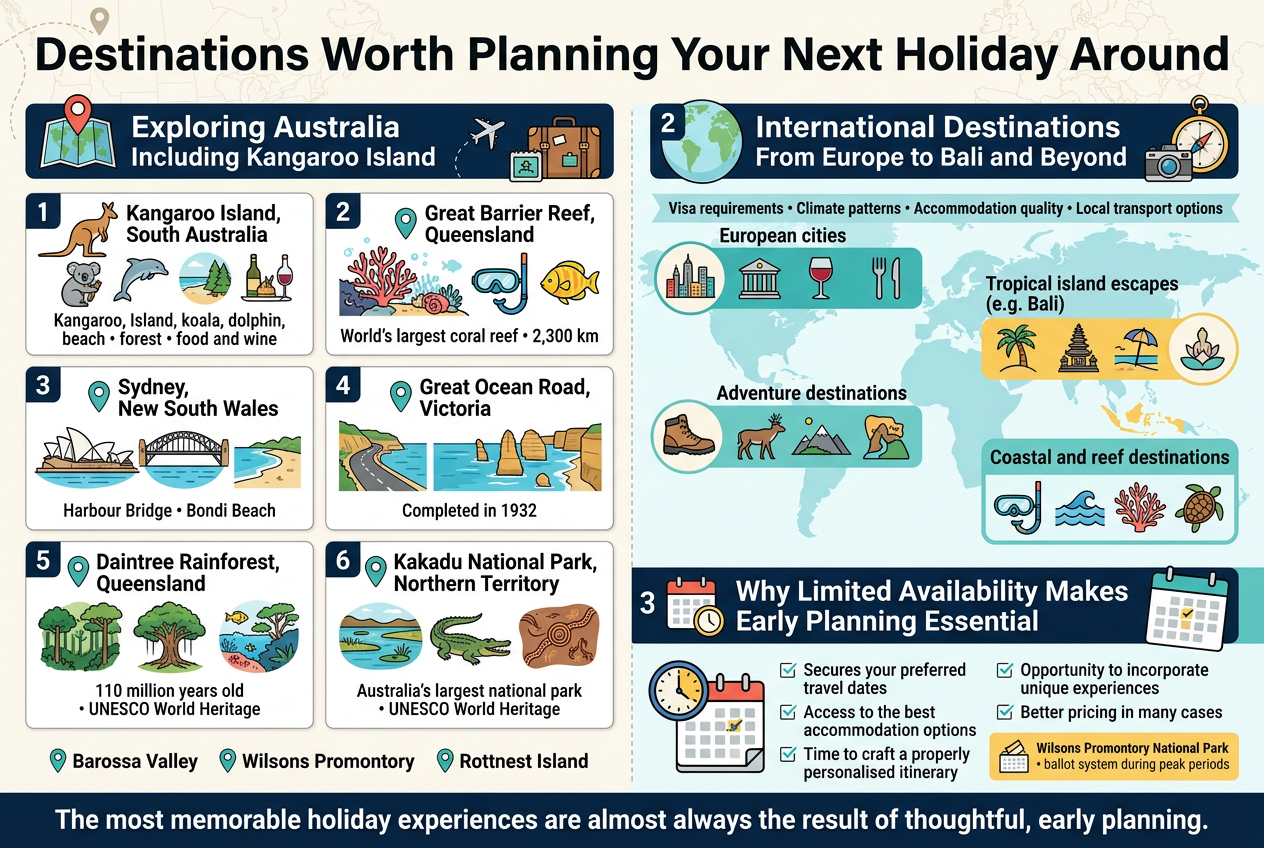
Exploring Australia Including Kangaroo Island
Australia is one of the most diverse travel destinations on the planet, and with good reason. As the sixth largest country in the world, it offers an extraordinary range of landscapes, wildlife encounters, and cultural experiences that could fill years of exploration. Whether you are drawn to the turquoise waters of the Whitsunday Islands in Queensland, the ancient wonder of Uluru in the Northern Territory, or the rugged gorges of Karijini National Park in Western Australia, there is genuinely something for every type of traveller.
Some of the most compelling destinations to consider include:
-
Kangaroo Island, South Australia – Just off the coast of Adelaide, this remarkable island is famous far beyond its name. Yes, you will encounter kangaroos, but the wildlife diversity here extends to dolphins, koalas, and so much more. Add to that its striking landscapes — from pristine beaches and towering sand dunes to dense forests and rolling farmlands — and you have a destination that rewards every kind of explorer. The food and wine scene on the island is equally impressive, making it a well-rounded holiday destination.
-
Great Barrier Reef, Queensland – Stretching an astonishing 2,300 kilometres, this is the world's largest coral reef and one of the planet's most extraordinary natural wonders. Whether you snorkel or dive, the sheer scale and beauty of the reef is unmatched.
-
Sydney, New South Wales – Home to iconic landmarks like the Sydney Harbour Bridge and the Sydney Opera House, Sydney is one of the world's most recognisable cities. It blends vibrant urban energy with stunning coastal beauty, including the world-famous Bondi Beach.
-
Great Ocean Road, Victoria – Widely regarded as one of the best road trips in the world, this scenic coastal drive was completed in 1932. The highlight for most travellers is Port Campbell National Park, where the dramatic Twelve Apostles rock formations rise from the Southern Ocean.
-
Daintree Rainforest, Queensland – At an extraordinary 110 million years old, the Daintree is the oldest existing rainforest in the world. Near Cape Tribulation, two UNESCO World Heritage Listed sites — the Daintree and the Great Barrier Reef — converge in a truly unforgettable landscape.
-
Kakadu National Park, Northern Territory – A UNESCO World Heritage Site, Kakadu is Australia's largest national park and home to ancient Aboriginal rock art, vast wetlands, and the famous saltwater crocodile population.
With destinations as varied as the wine regions of Barossa Valley, the coastal wilderness of Wilsons Promontory, and the island magic of Rottnest Island, planning ahead is not just helpful — it is essential.
International Destinations From Europe to Bali and Beyond
Now that we have covered Australia's remarkable domestic offering, it is equally important to recognise that expert-guided holiday planning extends well beyond Australian shores. The world is full of destinations that demand careful thought and preparation to experience at their best, and having a knowledgeable guide to help you navigate the options makes all the difference.
From the cultural richness of Europe — where historic cities, world-class cuisine, and centuries of art and architecture await — to the lush tropical paradise of Bali, international travel opens up a world of extraordinary possibilities. Each destination comes with its own set of logistical considerations, from visa requirements and climate patterns to accommodation quality and local transport options.
When thinking about international destinations, the variety available to travellers is immense:
| Destination Type | What It Offers |
|---|---|
| European cities | History, art, cuisine, architecture, and cultural immersion |
| Tropical island escapes (e.g. Bali) | Relaxation, natural beauty, wellness, and local culture |
| Adventure destinations | Wildlife, trekking, national parks, and outdoor experiences |
| Coastal and reef destinations | Snorkelling, diving, beaches, and marine wildlife |
Whether you are dreaming of sipping wine in a European vineyard, exploring ancient temples in Bali, or embarking on a wildlife safari, the same principle applies: the more personalised and carefully crafted your travel blueprint is, the richer and more seamless your experience will be.
Why Limited Availability Makes Early Planning Essential
With this in mind, one of the most critical factors that often catches travellers off guard is availability. The destinations covered throughout this section — from Kangaroo Island to the Great Barrier Reef to international hotspots — are not just popular in name. They are in high demand, particularly during peak travel seasons.
Consider that Wilsons Promontory National Park in Victoria is so popular among Melbournians that a ballot system is in place just to secure accommodation during peak periods. This is not an isolated example. Across Australia and internationally, premium experiences, sought-after accommodation, and guided tours with limited group sizes book out weeks, months, and sometimes over a year in advance.
Here is why early planning gives you a significant advantage:
-
Secures your preferred travel dates before availability closes off entirely
-
Access to the best accommodation options at the most desirable locations, rather than settling for what remains
-
Time to craft a properly personalised itinerary that reflects your interests, pace, and travel style rather than defaulting to generic packaged options
-
Opportunity to incorporate unique experiences — such as guided wildlife encounters on Kangaroo Island or reef diving excursions on the Great Barrier Reef — that have limited daily participant numbers
-
Better pricing in many cases, as last-minute bookings for popular destinations often come at a premium
Previously, many travellers assumed that holiday planning could be left to the last minute without consequence. Today, with travel demand at extraordinary levels across both domestic and international destinations, that approach carries real risk of disappointment. The most memorable holiday experiences — the ones that align perfectly with your vision — are almost always the result of thoughtful, early planning built around your specific needs and aspirations.
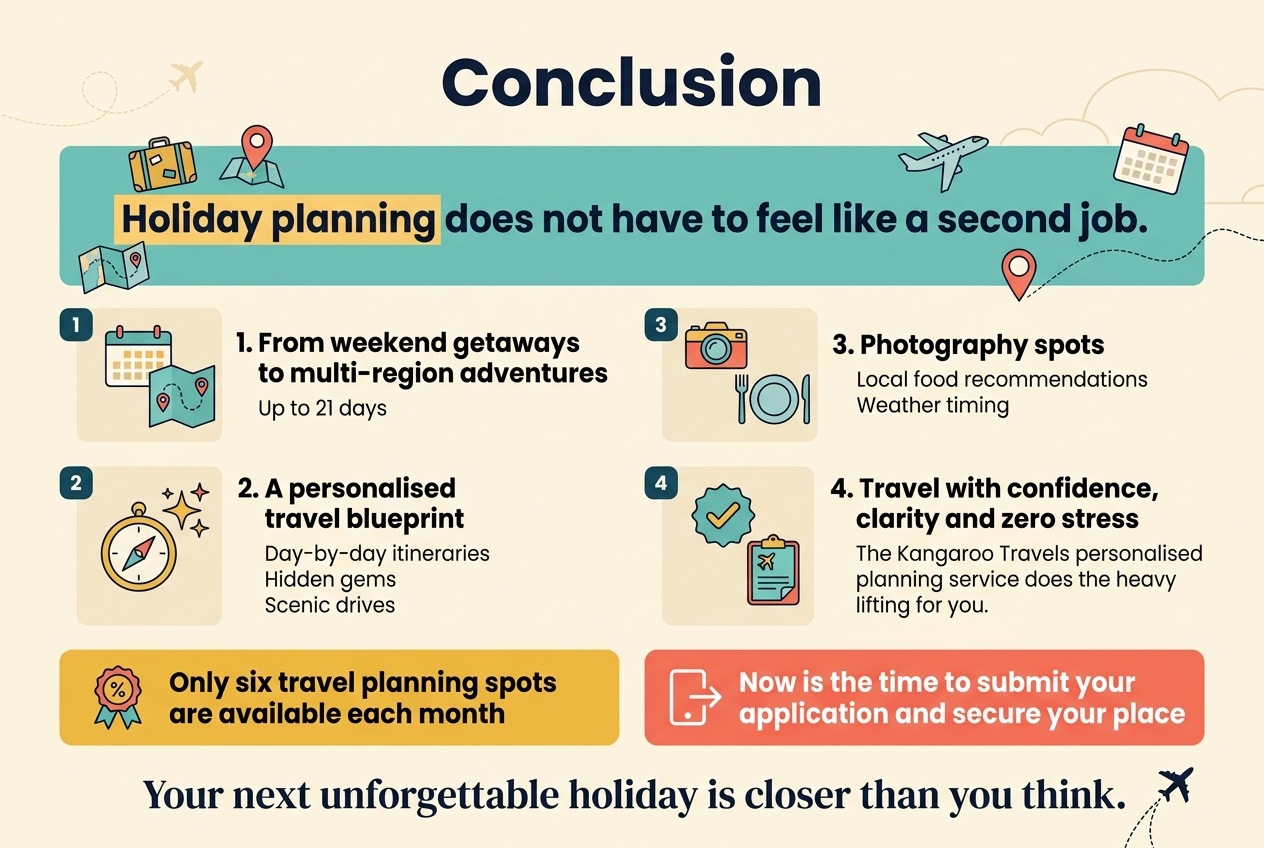
Holiday planning does not have to feel like a second job. From weekend getaways to multi-region adventures spanning up to 21 days, the right guidance can turn an overwhelming process into something genuinely exciting. A personalised travel blueprint covers everything from day-by-day itineraries and hidden gems to scenic drives, photography spots, local food recommendations and weather timing — so nothing is left to chance.
If you are ready to travel with confidence, clarity and zero stress, The Kangaroo Travels personalised planning service is designed to do the heavy lifting for you. Because only six travel planning spots are available each month, now is the time to submit your application and secure your place. Your next unforgettable holiday is closer than you think.
Post a Comment